Solo project2026
What actually moves employee satisfaction
Stress level and work environment predicted job satisfaction; demographic characteristics largely did not.
- responses
- 3,025
- test families
- 3
- predictors
- 5
- R
- tidyverse
- ggplot2
- R Markdown
Problem
Organizations often assume satisfaction varies by demographic group and target retention programs accordingly. This project tested which factors are actually associated with reported job satisfaction.
Data
A survey dataset of 3,025 responses covering satisfaction, stress, work environment, and demographic attributes. The data is synthetic (sourced from Kaggle), which bounds how far the conclusions travel.
Approach
Three families of test, chosen to match the variable types: chi-square for categorical associations, ANOVA for group mean differences, and multiple linear regression to evaluate predictors simultaneously. Analysis in R, with the full workflow published as a rendered R Markdown report.
Findings
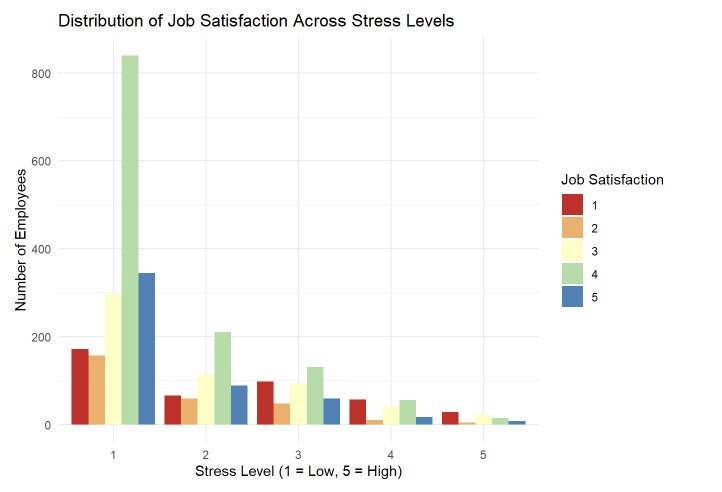
Stress level showed a strong association with satisfaction, and work environment was a significant predictor in the regression. Demographic variables contributed comparatively little once the workplace factors were in the model.
Limitations. The dataset is synthetic. The statistical relationships are real within it, but they were generated rather than observed, so the substantive conclusions should be read as a demonstration of method rather than a finding about real workplaces.
So what
The factors that predicted satisfaction here are ones an employer can change — workload and environment — rather than ones they cannot. That is the more useful place to aim a retention program, and it is testable on real internal survey data using exactly this workflow.